
AI for Small Business in Ireland: What to Automate and What Should Stay Human?
Key Takeaway
AI can save small businesses time on repetitive work, but it should support people rather than replace the human contact and judgement customers expect.
Artificial intelligence is becoming part of everyday business. Small companies are using AI to draft emails, summarise documents, organise information and reduce routine administration.
The opportunity is to use AI behind the scenes while keeping people involved in customer service and important decisions.
The FRS Recruitment Employment Report 2026 found that AI is increasingly being used to automate routine tasks and improve productivity, while relatively few organisations have used it to replace complete roles.
The Irish Government has also launched AI – Good for Business to make information, examples and supports easier for SMEs to access.
Why Is AI Relevant to Irish SMEs?
Small businesses often have limited time, staff and budgets. One person may handle sales, marketing, customer enquiries and administration during the same day.
AI can reduce some of that pressure. However, it can also misunderstand instructions or produce inaccurate information that sounds convincing.
The better question is not, “How much can we replace?” It is, “Which tasks can technology make faster while a person remains responsible for the result?”
Which Tasks Can Be Automated?
The best tasks to automate are repetitive, low-risk and easy to check.
First Drafts and Ideas
AI can help prepare routine emails, social posts, meeting agendas, product descriptions and internal procedures. It can also suggest campaign ideas or customer questions.
The output should still be reviewed for accuracy, tone and relevance. AI works best as a starting point rather than the final author.
Summaries and Organisation
AI tools can turn long notes into a short summary, identify actions after a meeting or arrange information under clear headings.
This can speed up administration, but the original information should be checked before the summary is used for an important decision.
Predictable Admin Processes
Online forms can send information to spreadsheets, trigger reminders and direct enquiries to the correct person. AI may help categorise enquiries, extract document details or prepare a suggested response.
Automate predictable steps, but require human approval where the result affects a customer, payment, contract or compliance decision.
What Should Stay Human?
Some parts of a business depend on trust rather than speed.
Calls and First Impressions
A caller may be uncertain, frustrated or unsure which service they need. A real receptionist can listen, ask follow-up questions and adapt.
A professional call answering service can ensure enquiries are answered in the company’s name when the team is unavailable.
Businesses that need more detailed handling can use a virtual receptionist service for agreed scripts, call routing and clearer message capture.
A separate number can also help a start-up look more established. Our guide to choosing a business phone number in Ireland explains the difference between a personal mobile and a dedicated business number.
Complaints and Sensitive Enquiries
Complaints, payment problems and personal situations require empathy and judgement. An automatic response can make a difficult situation worse.
AI may help prepare information, but the final communication should come from someone who understands the circumstances and can take responsibility.
Important Decisions
AI can organise information and suggest options. It should not make the final decision on hiring, contracts, legal matters, finance or customer disputes.
Business owners remain responsible for checking information and seeking professional advice when necessary.
Can AI Replace a Receptionist?
AI can answer basic website questions, direct visitors to information and collect initial contact details. This can be useful outside normal working hours.
That is different from managing a live call. A receptionist can recognise urgency, clarify what the caller needs and decide whether to transfer the call or take a detailed message.
Where an enquiry involves an appointment, a human-led diary management service can book it according to the business’s availability and agreed rules.
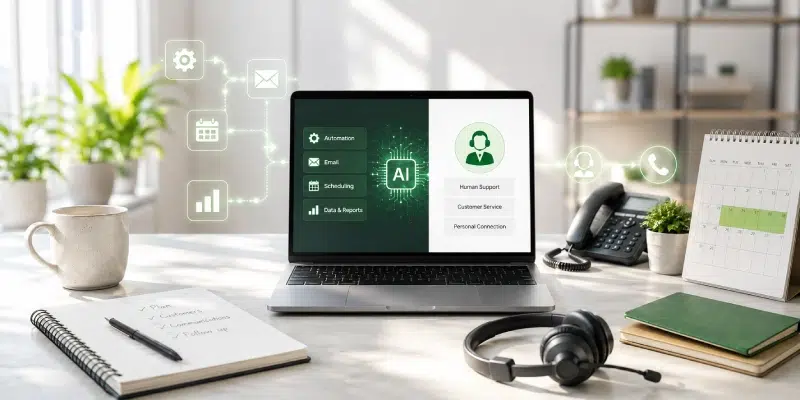
For many SMEs, the strongest approach is AI for internal efficiency and real people for customer-facing communication.
How Can a Business Use AI Safely?
Businesses should understand what information is being entered into an AI tool and how the provider processes it.
The Data Protection Commission’s guidance on AI and data protection advises organisations to assess the risks where personal data is processed through AI systems. GDPR obligations still apply when a new tool is introduced.
Before using AI, a business should:
- Avoid entering confidential customer, employee or financial information into an unapproved public tool.
- Check the provider’s privacy, retention and security settings.
- Set rules covering who may use the tool and for which tasks.
- Require human review of published content and customer communications.
- Keep records of important decisions.
- Review the tool regularly.
The Regulation of Artificial Intelligence Bill 2026 also reflects Ireland’s growing focus on responsible AI use and implementation of the EU AI Act.
How Should a Small Business Begin?
Start with one clear problem rather than purchasing several tools at once.
Choose a repetitive task that carries limited risk. Test whether AI can make it faster, compare the result with the current process and set rules for checking the output.
Irish SMEs may also be able to access support. The Local Enterprise Office Digital for Business programme can provide eligible businesses with a digital assessment and roadmap.
Businesses that meet the conditions may then qualify for the Grow Digital Voucher, which supports eligible software, training and IT configuration costs.
Combining Technology With Human Support
AI for small business in Ireland should not be treated as a choice between technology and people.
Technology can handle repetitive background work. People should continue to deal with customers, make decisions and take responsibility for the outcome.
Sky Business Centres supports companies that want to operate efficiently without employing a full in-house reception team. Services include call answering, virtual receptionist support, diary management in our complete virtual office Dublin packages.
By automating the right tasks and protecting the areas that need human attention, small businesses can save time without weakening the customer experience.
Frequently Asked Questions
1. How can a small business use AI?
AI can help create first drafts, summarise information, organise notes, generate ideas and support repetitive administration. Important outputs should always be checked.
2. Which tasks should not be fully automated?
Complaints, sensitive enquiries, hiring, contracts, financial decisions and communications involving personal circumstances should retain human oversight.
3. Will AI replace call answering services?
AI can handle basic online questions, but live calls often require listening, clarification and judgement. Human call answering provides a more flexible experience.
4. Is it safe to enter customer information into an AI tool?
Not automatically. A business should assess how information will be processed and whether its use complies with data protection requirements.
5. Are AI supports available for Irish businesses?
Yes. AI – Good for Business provides information and examples, while Local Enterprise Offices offer Digital for Business and the Grow Digital Voucher to eligible companies.
Ready to get started with a professional Dublin business address?